Image
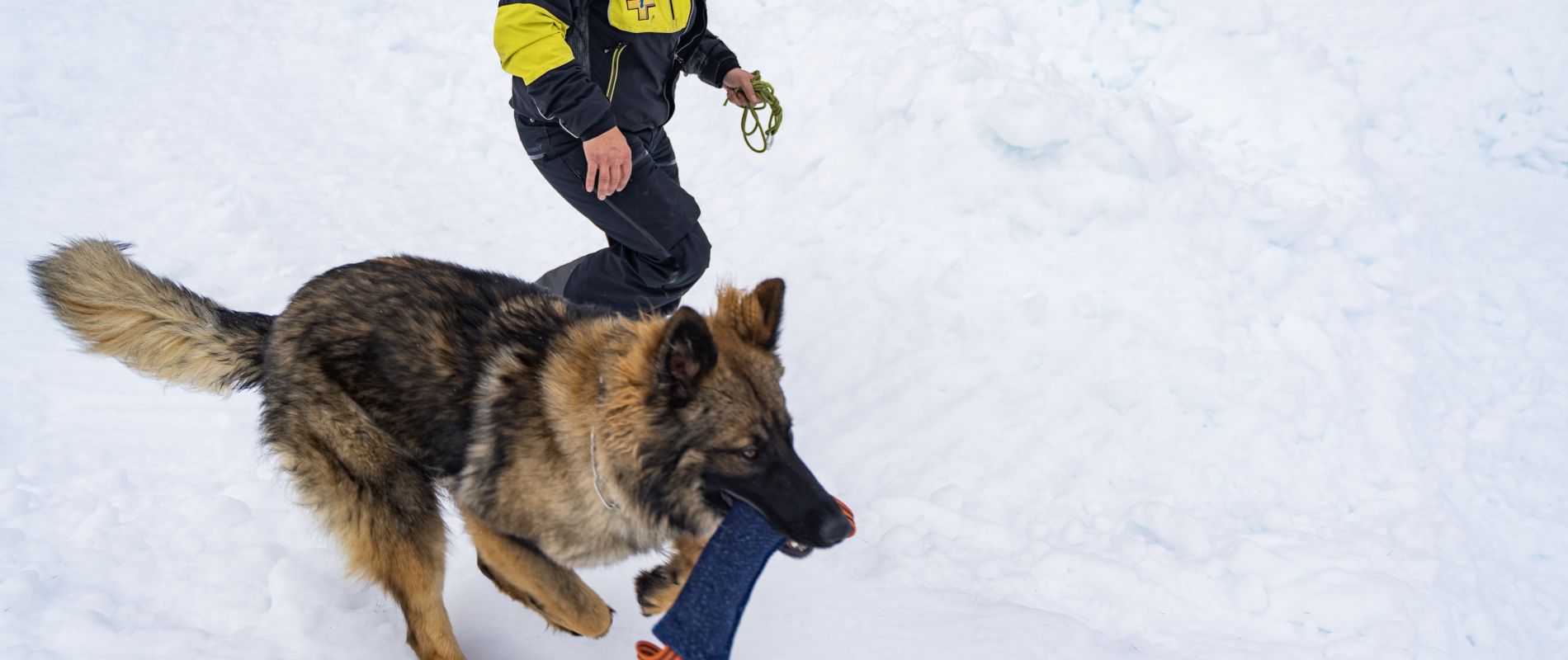


When heavy snowfalls weaken the snowpack at Les Orres, the risk of avalanche rises rapidly, threatening both skiers and the ski area. Although the ski patrols and artificial rescue teams regularly secure the ski area with avalanche control plans (PIDA), the mountain can never be completely tamed. In this context, avalanche dog handlers play an essential role : trained to detect and rescue victims, they and their human teammates form an indispensable line of defense against the hazards of winter.
In this article, discover a day's immersion training with these specialized teams - from the ski patrollers to the loyal, high-performance dogs - to understand how they prepare to intervene in real conditions and guarantee everyone's safety on the slopes.
Follow us for an exciting day up close and personal with Les Orres' guardian angels!

"We don't train to hope, but to be ready". With these words, Stéphane Henry, Director of the Pistes Department, opens this exceptional day of avalanche training in Les Orres.
We board the Pousterle chairlift, heading for the training site. Above us, the clouds still seem to be laden with snow, reminding us that the avalanche risk is very real. TheAssociation des Maîtres-Chiens d'Avalanche des Hautes-Alpes is already hard at work. It brings together all the department's dog handlers: pisteurs-secouristes, CRS Alpes, PGHM, firefighters and refuge wardens, forming a veritable mountain safety chain.
Cheerful barking welcomes us: the dogs, faithful four-legged companions, are in their element. Some are already fully operational, while others are undergoing initial training or operational refresher courses. These sessions are strategic: they enable us to check and maintain the skills of the dogs and their handlers, which are essential for operations in winter conditions.
The day's scenario is realistic: a false victim is buried under the snow to simulate a critical situation. A search area is marked out, and the dogs start sniffing the ground in a concentrated manner. One of them quickly locates the victim. The first-aiders, probes in hand, follow closely to free the person and maximize his or her chances of survival. Every gesture, every training session is designed to deal with real-life emergencies on the Les Orres ski area.


When training in the mountains for the first time, timing and precision are essential. Every detail counts to ensure that the exercise mirrors a real avalanche situation as closely as possible.
A person is buried under a thick layer of snow, reproducing the exact conditions of an avalanche.
The avalanche dog must associate the victim's scent with his toy, the "pudding", which serves as a reward and motivation. This technique boosts search efficiency and stimulates the dog's natural instincts.
Dog handlers methodically dig a hole to let the scent escape. Guided by this olfactory signal, the dog's exceptional sense of smell can locate the victim quickly and accurately.
The dog explores the area, following the scent signal to detect the victim. Coordination between handler and dog is crucial to maximize the speed and efficiency of the operation.
As soon as the victim is detected, the dog scratches or indicates the location, enabling the first-aid team to take over.
⚠️ During an avalanche search, the dog must never touch the victim. The dog's job is to locate the exact spot where the avalanche has buried the victim and report it to the pisteurs. The latter then carry out the sounding and clearing, sometimes with several waves of sounding to guarantee safety and optimize the chances of finding the victim alive.


For Maxime Magnan, becoming an avalanche dog handler is not just a profession, it's a true passion. This summer, he chose Ava, a 9-month-old bitch, to accompany him in his apprenticeship. Since autumn, the pair have been training rigorously, step by step: learning to stay focused despite distractions, reinforcing interest in the search toy and progressing to more complex avalanche victim search exercises.
"I can't imagine having a dog and leaving it at home," confides Maxime. The animal lives with its master on a daily basis: a bond of trust and complicity that is essential for mountain rescue operations, where every second counts.
Becoming an avalanche dog handler requires patience, regularity and long-term commitment . Initial training lasts one year, from summer to summer. This is followed by pre-training, then the full curriculum with specialized training sessions, preparing the duo to operate in the most demanding conditions.
In the final analysis, being an avalanche dog handler means working in a profession that is both useful and demanding, where passion and commitment are placed at the service of skiers' safety. Behind every dog and every handler lies a discreet but vital task, to protect the mountains and those who practice them.


The Association's dogs are trained through play, never through coercion. Their training is based on searching for their toy, the"boudin", which they then associate with finding a buried person. This playful approach keeps the dog focused and fully committed to its mission, transforming a vital exercise into work that's effective, fun and motivating.
" For the dog, the objective is to find his toy... and then the person ", explains Mathieu Belenguer, a first-aid rescuer and dog handler in Les Orres.
Thanks to his exceptional sense of smell, the dog can detect the scent of a victim under the snow, even in the presence of distractions, and quickly cover large areas.
A dog can explore 1 hectare in just 20 minutes, a crucial capability in avalanche search operations.
In the mountains, certain breeds are particularly adept at rescue, becoming true four-legged heroes.
Together, these loyal companions turn every rescue mission into a dance of courage, instinct and dedication, reminding us just how vital they are to mountain safety.


At the end of this day of training and specialist interventions, we realize just how essential the relationship between handler and dog is for effective rescue on snow-covered terrain. These pairs, trained with patience and rigor, are an indispensable link in mountain safety, always ready to intervene when an incident occurs. Above and beyond their technical skills, it is their dedication and complicity that make them true guardians of the slopes.